
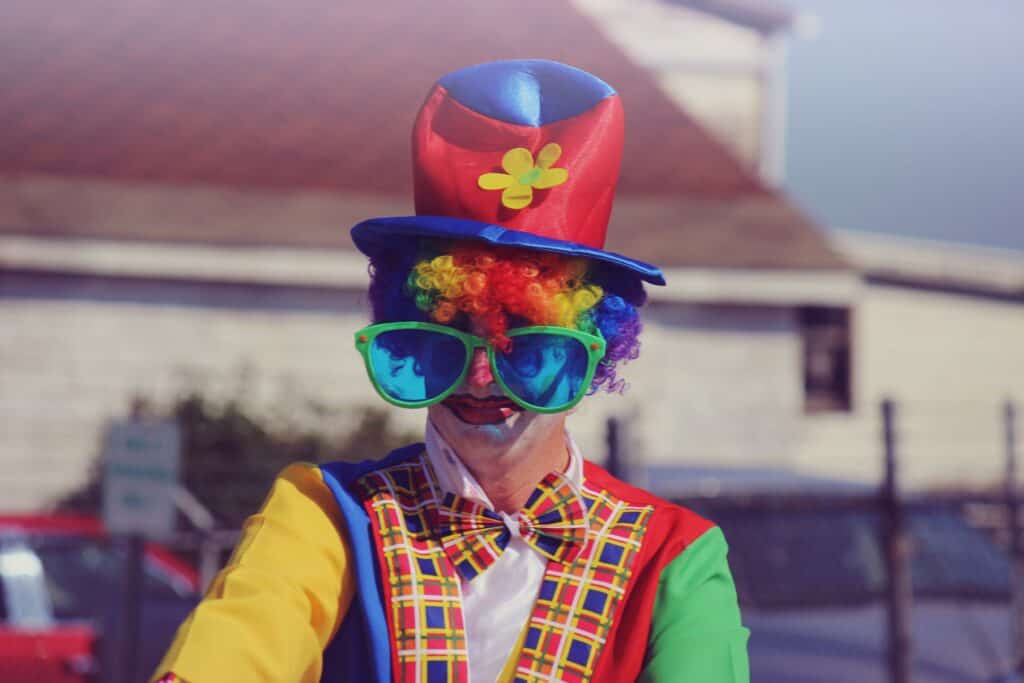
In the theme of Throw Back Thursday, I thought I’d try Little Known Wednesday and let’s start looking at some more interesting psychological disorders.
Our first is…Coulrophobia….OK now no copy, past, and running off to google! Obviously, breaking down the word, we are looking at a phobia. Could it be fear of colors (or colours if we were in the UK!).
It’s a fear of CLOWNS! I have to admit with 20 years of Psychology under my belt I had missed this one myself, so if you didn’t get it, don’t beat yourself up. I came across it quite by accident. Let’s have a quick English (or actually Greek) lesson and break down the word: Coulro comes from the Greek “one coming on stilts” and Phobia is a severe fear. Often individuals with phobias experience symptoms including severe sweating, heart palpitations, nausea, extreme terror and often will be convinced that they are either having a heart attack or often will report that they feel like they are “dying.”
So, Coulrophobia is a phobia of clowns. To prevent this does this mean we should never take our children to the Ringling Brothers Circus or birthday parties with clowns? I remember going to the circus many years in my childhood, and a few times with both of my children well until I got worried about the treatment of animals, etc. As a child I can’t say that I adored the clowns but I never got hysterical if my father bought me a balloon or cotton candy from one of the red-nosed, big footed created men or women because I was more focused on the fluffy pink stuff in the bag. As I got older and had children my fear actually developed but it wasn’t about the clowns per say. It was more about knowing that my daughter would lose the balloon because she wouldn’t have let me tie the string it to her wrist and I’d end up suffering through an hour of tears and loud sobs all the way home or I’d be forced to go back through the crowds rushing towards me and the parking lot to get home, in order to find a clown (good luck with that after the “Big Show”) to purchase yet another balloon to appease my tear-stained, hyperventilating child in her stroller! Now I did some research, there is a phobia called Globophobia, which is a fear of balloons (so if you guess that on seeing the first picture well done you!).But I couldn’t find any phobias about loosing balloons and dealing with screaming children. But, if you find that, please shoot me a comment! You never know when that will be the next patient to pop into my office.
Back to Coulrophobia, the fear of the SOURCE of balloons, cotton candy,those funky lighted necklaces and very drippy ice cones at the Circus and Birthday Parties. What is terrifying about clowns? And is Coulrophobia a REAL phobia or fear? And how do you deal with this when your darling 5-year-old begs you to take them to the circus and you end up in a pile with a rapidly emptied pop corn bag over your mouth.
Research has shown that (wait for it) Clowns are scary! In July, 2013, The Smithsonian Magazine wrote an extensive article on the History and Psychology of Clowns Being Scary. Among other things, they do discuss that the DSM (The Psychiatric Bible for all things Mental Health) mentions Coulrophobia not by name but under what we call an “umbrella category” of a “specific phobia,” (DSM-V code 300.29 ). Now in the DSM-IV (the predecessor of the V) had it listed under pediatric phobias of clothed characters such as Micky Mouse, Santa Clause, and sport’s mascots. Which makes sense if you have ever tried to drag your child to see Santa at the mall for that special First Christmas Card picture and when baby gets handed to the jolly man with the beard, s/he goes hysterical! It happened with both my girls (they are 10 years apart), when they were both little they loved having me read the Night Before Christmas, were so excited about the tree, and ornaments, begged for me to write their list to Santa, then when we went to the mall the closer we got in the line, the harder my daughters were breathing.By the time they were unhooked from the stroller the tears, runny nose, screaming were in full form. Nothing calmed her down. So, was she just a nervous kid? Had a beard issue? Or did she sense something behind the beard that I didn’t? Or was the beard like the grease paint on a clown – she couldn’t make contact with the stranger and that terrified her senses?
In 2008 BBC News reported that there was a University of Sheffield Study that pronounced :KIDS HATE CLOWNS! The study interviewed 280 children ages 4 – 16 and determined that clowns were found “to be frightening and unknowable.” So, what is so specifically terrifying about clowns? I saw Patch Adams, Robin Williams helped tons of children with a rubber clown nose, well actually with a Medical Degree, but you get the drift.
Clowns typically are individuals that are hidden behind a lot of grease paint make-up, many with eerie or creepy smiles painted on. They have large amounts of wild bright or multi-colored hair, wearing brightly colored baggy clothing, nothing like children have seen. Often clowns in circus’ come out in a pack from all directions in the big circle. For children the feeling of being out numbered by characters that have exaggerated makeup, with enormous bow ties, could be terrifying. They tend to move quickly, darting here and there, doing things that appear to be logically impossible 20 of them piling out of a tiny car for example. Or an adult sized clown with huge feet peddling a child size tricycle. To children this may not make sense. Again, you can’t see their faces so you can’t pick up facial messages. Yes they have a “pretend” smile painted on but are they really friendly? Often individuals with clown fear report that it started in childhood they perhaps remember going some place where there were clowns and it terrified them and they couldn’t get to a safe place. In other words, after Mom and Dad spent $13 a ticket for the family to see the “Greatest Show on Earth” and they freaked out, Mom and Dad weren’t going to pull the older kids out because the little one was freaking out. And this one traumatic experience can affect someone for years or decades. Often if you are very young you may have actually forgotten or repressed the cause of your phobia.
Treatment
There are many treatments for phobias and clown phobia is treated just like others. Systematic Desensitization is a common and effective way to treat phobias. You are taught a relaxation exercise (such as self-hypnosis), create a list of scary situations that lead up to your fear (being with the clown), and then slowly working through each step.Starting with something not so scary ( a small picture of a red clown nose) and working up to a relaxation exercise where you are actually with a clown. Then, perhaps going to a place to see a clown. This is effect but needs to be worked through VERY slowly and gently.
Biofeedback can also help with anxiety and phobias, as well as hypnosis itself.
Flooding is another treatment for phobias that I, personally, don’t use. Flooding immerses the individual in to the fear response until it eventually fades away. I’m sure this is very successful for many individuals, but working with a lot of PTSD patient’s I try to avoid flooding, without control. But that’s just me.
Well…this was Little Known Wednesday. The word for today is Coulrophobia and I promise to write more about treatment of phobias in the future since I know I just whipped through them. I don’t specialize in phobias per say, so if you want to have treatment for a severe phobia consider going to www.psychologytoday.com and look for someone in your zip code that works with Phobias (not just anxiety that I do work with).
Thanks so much for popping by, and I hope you return very soon.
Gentle Hugs, Dr Karen Hoving (AKA “admin”)
www.facebook.com/drkarenhoving